Search This Blog

Wednesday, July 11, 2018

Do you have mid or low back pain or problems in your hips? This class will help you if you do.


Much of our back pain and a great deal of hip, leg, knee or ankle/foot pain develops because we don't use/move the upper and lower parts of ourselves in a coordinated, connected, and organic way. This means your shoulders have forgotten that they are connected to your pelvis and legs, via your back! This can also account for misalignment that occurs down through the knees all the way to the feet. Of course knee pain can also be caused from misalignment of ankles, i.e., pronation or supination (rolling in or out; you can feel both or either, when you notice how the bones in your feet take the weight of gravity into the floor).

Class this week addresses this problem and will teach you to use your back to support movement through the hips, legs, knees, ankles and feet, AND to use your lower extremities to initiate, support and organize movement through your back, shoulders, spine and head.

Learning to move like this is a basic principle of the Feldenkrais Method - distributing work (movement) throughout the skeleton, through the whole body. Initially this can only occur when you are paying attention to how you move, meaning  paying attention to your existing movement habits and patterns. Then you will see where the disconnect actually lies, or rather, you will FEEL it.

Even if you've never been to a Feldenkrais class before, you can do yourself some good now by noticing how you move, what you feel, where your body parts are, as you go through your day. Try it and you'll begin to see changes that your body will instinctively make to organize your movement more intelligently. Our bodies are fabulous that way; once you understand how much difference using your attention makes on your movement and your brain, you'll begin to see the possibilities for real, lasting change in yourself.

If you wish to attend a class, please contact me using the form on this webpage and I'll send you the class handout.  I'll also be glad to answer any questions you may have about the Feldenkrais Method.

Feldenkrais classes can make a huge difference in your life when you are out of touch with your body, or if you have aches and pains, or want to restore vitality, creativity and effective movement again. It will improve your performance in nearly every activity you do.  All you need to do is participate with commitment -- i.e., be interested in: developing attention and self-awareness of your brain and body; learning about yourself and your movement in a new way; and being prepared to feel better and more effective in your life again. Does this interest you?


Sunday, July 8, 2018

Neck pain - Is your head tilted forward toward the front of your chest, rather than on top of your spine?

A little more about dowagers' hump, also known as buffalo hump, kyphosis, kypho-scoliosis and simply, osteoporosis of the upper thoracic, and/or lower cervical spine. 


When the head is pitched forward over the chest due to habit or anatomy, it affects your whole body, including your vertical and horizontal alignment, your balance and it creates downward shearing forces that enter the skeleton due to misalignment. These are elements that affect your safety, comfort and the ability to move and feel well. 


When I searched 'dowager's hump' online,  I found differing and inconsistent names, symptoms, definitions, descriptions and discussions about the cause and treatment of the fatty deposit around the base of the cervical spine:  from taking more calcium, up to and including injecting a synthetic cement-like substance into the vertebrae to hold them in place and keep them from collapsing forward. Or scary manual manipulation. But there was very little agreement on causation or treatment.

I also did not find anything much to do with improving movement, neither in the entire body, nor in the affected and related areas, as a sane and effective approach to treatment and/or prevention. Simple, non-invasive approaches are the hardest to find, sadly.

In the Feldenkrais Method, however, mobility through the entire body is a key principle of health: our general approach to the body is that the greater capacity for movement and flow through the body that one has, the better one feels. The more that work is distributed through the entire skeleton, the better the body functions, bears weight, balances, stays upright, and is able to do the tasks and activities that make life a joy and worth living. 


In general we humans tend to have far more issues and trouble related to too little movement than problems from doing too much, excluding, of course, our ridiculous capacity to over-do in short spurts and actually injure ourselves. This we do because we do not pay attention to what we are feeling in our bodies, but that is a discussion for another time.

Thus increasing mobility and comfort means more and better movement and quality of life. More energetic flow, creativity, vitality and sense of freedom, all of which contribute to a better sense of self, more self-awareness and consciousness. When we improve movement in any part of our body, it affects everything else. Reclaiming more movement between the shoulder blades gently and rediscovering the upper thoracic spine will change your outlook on life, literally. 

So at minimum, 
  1. Begin to pay attention to where your head and body are in space. 
  2. Lie on the floor and see how far away from your chest is from your chin. 
  3. If your chin is far from your chest and your head rests on the ground toward the top of the head, it means you probably have the pitching forward from your 7th cervical vertebra that is associated with a developing dowager's hump or immobility in this region. 
If you'd like to learn more about classes or individual work, I'd be happy to talk with you. Use the contact form at the top of the page to reach me quickly.  
Best wishes,
Carole 


A beautiful demonstration: Feldenkrais - How it Works - with English subtitles


Once our awareness is awakened, our possibilities for improvement on nearly every level are almost limitless.


If we wish to transform habits, patterns -- physical, mental and emotion – that no longer work for us, our awareness, attention and connection through sensation will open this magic door. True, whether the non-working pattern (accommodation) is due to injury, surgery, repetitive action, disorganized brain map, age, or has been with us since birth.

I invite you to watch this lovely short video by Feldenkrais trainer Mara Fusero, in Milan, Italy. Feldenkrais trainings and the practive of the Feldenkrais Method, i.e., Awareness Through Movement classes and Functional Integration individual sessions, are done all over the world by people of every age, background, condition and requirement, from infancy to those nearly end of life.

If you are in the Reno-Tahoe-Northern NV area and want more information, please contact me, using the form at the right, above.

Best wishes,
Carole Bucher, BA, GCFP


Thursday, July 5, 2018

What is Feldenkrais Functional Integration? Jeremy Krauss demonstrating a Feldenkrais - Functional Integration lesso...


If you have wondered about the individual, hands-on part of Feldenkrais, this is a demonstration of  lengthening the body through the arm, shoulder, ribs and spine. It is a lovely, empowered way to improve your musculoskeletal organization, comfort, efficiency and alignment, while learning new ways of moving that will positively influence nearly everything you do.  Contact me if you are interested in finding out more about the Feldenkrais Method.


Sunday, July 1, 2018

Do you know what a Dowager's Hump is? Do you know if you are getting one?

Hi Everyone,


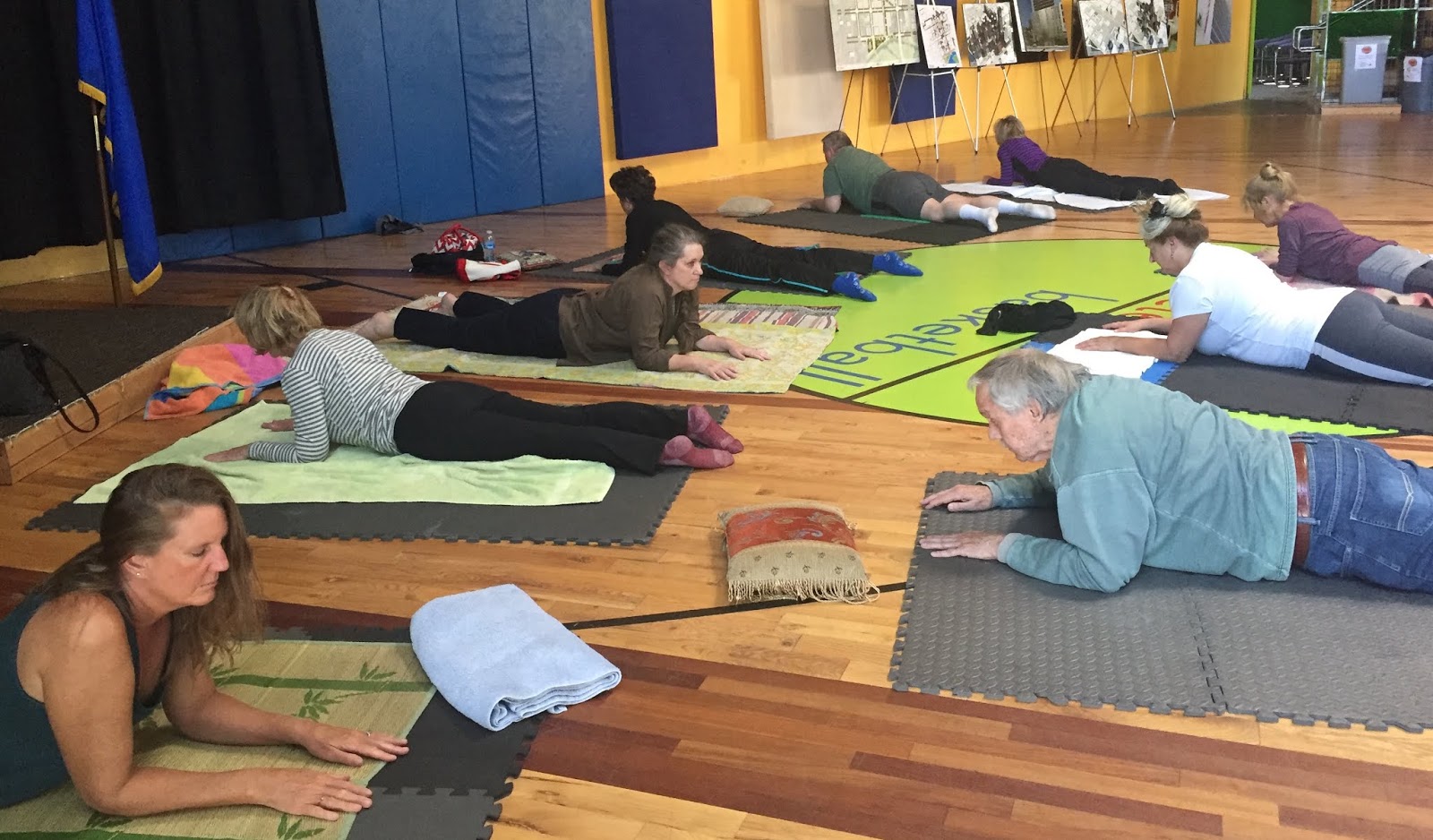
Our Reno Feldenkrais Awareness Through Movement class this week is an AY lesson called "sinking the spine" -- which deals with that mysterious part of the spine between the shoulder blades. It is there, when there is not enough movement, that the dreaded 'dowagers' hump begins to form, in both men and women.

This is also a wonderful lesson for chest/ribs, shoulder and spinal mobility and flexibility, it improves breathing and shoulder join/arm function as well. Much of the lesson is done on the stomach, so be sure to bring a small towel for propping.

If you are coming to your first class, please contact me for the class handout and plan on being at class 15 mins early. Use the contact form on this website to reach me quickly and easily, or email me at renofeldenkrais@gmail.com.

Best wishes,
Carole

Carole Bucher, BA, GCFP
Renofeldenkrais.blogspot.com


Friday, June 29, 2018

Sit Spot Lesson 2 - Nature and Feldenkrais® Practice for Clearing 5 Senses


A wonderful Feldenkrais way to begin increasing your SENSORY self-awareness and contact with your body, while grounding and de-stressing.


Monday, June 25, 2018

Learn from your children about movement this summer

June 2018 |
BY CAROLE BUCHER, BA, GCFP |
RENO FELDENKRAIS INTEGRATIVE MOVEMENT
Pay more attention to how your children move; it can help you be more active this summer.

Take time to watch your kids do things this summer. They move their small bodies in amazing ways. Their physical organization is compact and light, their movement spontaneous and coordinated. Watch them squat, or run, or climb or walk; their bodies are counterbalanced and aligned, their movement integrated.

If you’re over 50, your movement probably doesn’t look or feel like that. The older we get, the truer this is; we barely remember what being well-organized, comfortable, energetic and aligned feels like. Can we restore a glimmer of our former easy movement? Yes, absolutely.

One great way is to notice what we feel in our bodies as we move. Children do this instinctively. Movement flows through them from head to toe like healthy, graceful animals. They are aware of where their bodies are in space (proprioception) and in movement (kinesthetics). They don’t need reminders to be conscious of themselves as adults do.

Kids learn from everything they do, in brain and body. Their movement is integrated, solution-oriented and uninhibited. If one movement strategy doesn’t work, or feels uncomfortable, they try something different. In this way, children develop individual, user-friendly patterns of movement that really work.

Can we move and be more like kids in our adult bodies? It’s not as simple as it sounds. The differences in our physical structures are vast: the relative size of bones to height, spaces between joints, thickness of cartilage, presence/absence of injury and age-related changes make a big difference.

Our best option is to focus on “how” kids move — the essence of their movement — rather than trying to copy them.

So we focus on how:

  1. our feet feel on the ground, sensing gravity and weight,
  2. our limbs move through space,
  3. movement originates from the center of ourselves, from the pelvis — kids have a low, stable center, which for adults might feel “martial-artsy” ; and
  4. to be lighter, less self-conscious and inhibited in movement.

Self-consciousness is a learned response that drives a wedge between others and us; when learned as a child, it goes with us into adulthood and contributes to feelings of disconnection, tension and being different. Sound familiar?

Here’s what can help: Building confidence through stable, centered, non-habitual movement will help repair disconnected feelings. Playing movement games with our kids is a great way — fun, improvisational games like follow-the-leader and charades, with mimicking, mime, and lots of unstructured movement.

These help to loosen and lighten us, something we really need today. Activities like these give us time away from computers and smartphones too. Try them outdoors.

And a few more tips: When playing games, watch everyone’s movement carefully, including your own. Look for movement patterns and habits. Have fun exploring new, different forms of movement as animals or movie/book characters.

As you wake up awareness in your brain and body, you develop a playful, interested, light-hearted attitude.

Laugh, share and have fun with your kids! Connect more deeply to yourselves and the world around you — a rewarding summer project. And no special equipment needed. Everything you need, you already have.

Carole Bucher, BA, is a Guild-Certified Feldenkrais practitioner/teacher and owner of Reno Feldenkrais Integrative Movement.

Saturday, June 16, 2018

2 Important NEW things about Reno Feldenkrais classes:

(1)  Please remember this date and time:  July 5, 2018, 5:00 PM

On this date, at that time, my Thursday Feldenkrais Awareness Through Movement (ATM) class, which is also the Beginners' portal to the Feldenkrais Method in the Reno/Tahoe area, and the ATM class for people who want a slower, gentler, more meditative Feldenkrais experience -- we will begin a new meeting time, change from 6 pm. This time change should make it more convenient for people to participate since it is not at the dinner hour. I hope this will be a positive change that will continue into the foreseeable future.


(2) Below is a 1+ min video & audio of my Thursday class, taken this week near the end of class. It will give you a good taste of what the Thursday class is like. All classes begin with body scans that will help you have a clearer sense of where and how your skeleton is aligned at the beginning of class. This initial awareness gives you a baseline from which to measure and experience change in your body as we slowly work on movement sequences to reveal to you where and what kind of movement is easy for you and what is not. Please turn up your computer volume if you cannot hear my voice on the video. And if you have any questions, please use the contact form in the upper right hand corner to reach me quickly and easily. 


Monday, May 21, 2018

Softer, Gentler, Quieter Beginner & Ongoing Awareness Through Movement Class for People Who Want This


CHANGE -- Thurs 5-6:30 pm (as of July 5, 2018) Feldenkrais class at the Reno Buddhist Ctr (820 Plumas at Taylor, enter on Taylor St.) is now the official BEGINNERS ATM (Awareness Through Movement) class. 

Every week I will teach lessons that are relaxing, simple, organizing and meditative. The class will help people who want quieter, gentler support for movement issues and nervous system function; chronic pain; long-term health issues; trauma and stress relief; MS and Parkinson's; post-stroke, surgery or injury; cancer. 

This class is also for people who want a quieter, deeper way to connect with themselves to find wellbeing, integration and transformation. Everything begins with self-awareness. 
This is where we start, every class, every time.  
Hope you can join us! 

Use the contact form in the upper right corner if you have questions or want to discuss something privately. 

Best Wishes! Carole 


The Positive Effect of Skeletal Awareness on your Psychological Self Image


HEALTHY BEGINNINGS MAGAZINE, MAY 2, 2018
  • BY CAROLE BUCHER | RENO FELDENKRAIS INTEGRATIVE MOVEMENT


      Buried right below the surface of your skin, More or less in plain sight, is your skeleton, the most important mental health resource You've never heArd or thought about, right? Surprisingly, the skeleton contributes a large and direct component to our mental health once we have an active connection to it. 
So why don’t we have this already?
The short answer is — 21st century disconnection from ourselves, made
worse by a few specifics.
Take a look at your own body. Our bones are well concealed by skin, muscles,
fat and hair, and much of the time, by our clothes. Being mostly out of sight, we
don’t generally feel our skeleton until we bruise or break something. Even then,
our bones are tough, having the tensile strength of cast iron, so you might think
we’d be more aware of them.
Perhaps not surprisingly, once we begin to experience skeletal support, something
organic in us responds to this strength, and an almost magical process sets in
motion. Our sense of self begins to change fundamentally.
We feel the quiet, deep and neutral support of our strong bones — reassuring,
pervasive and, for many people, transformative. We are paying more attention
to our bodies. We feel more self-confident; our posture and movement improve.
This is evident in my Feldenkrais classes when students discover they’re no l
onger locked into cycles of pain and instability. Negative habits shift, bodies
become lighter, better aligned, attitudes more optimistic. People learn real
self-care and begin to take more responsibility for how they move, feel and act.
No matter our condition, with more attention, our access to strength and support
from our skeleton means we are sending more positive messages to the brain.
Using ‘body language’ is another way to do this. Body language is a powerful
two-way communication tool. It informs our own brain as much as it does those
around us. When we move in ways that connect us to our inner skeletal strength
and support, we feel it!
That is also true of our habitually weak, self-defeating postures. So we want to
know what we communicate through our bodies, consciously and unconsciously.
Are we standing tall, eyes at the horizon, engaged? Or stooped, fatigued, eyes
down, spine slumped?
These things really matter. And we will notice them if we work at it. Click here to
see the famous tedTalk presentation
 
by Amy Cuddy that explains what I mean
in detail.
Dr. Feldenkrais worked with similar concepts more than 80 years ago. Although neuroscience has yet to completely explain the mechanisms of action, we know
that using the brain to change the body and the body to change the brain are
powerful interrelated, exciting concepts (see Dr. Norman Doidge’s books).
The process begins by finding our skeleton, feeling how our bones provide structure, support and strength to body and psyche.
All we need to do is slow down and focus on our body. We can do it anywhere:
at work, in the store, while exercising. It is a useful, mindful way to ground and
reduce stress and tension, to discover our own power to improve our health and
wellbeing. It is part of our remarkable capacity to heal, fueled by our desire and commitment.
Carole Bucher, BA, is a Guild-Certified Feldenkrais practitioner/teacher and owner
of Reno Feldenkrais Integrative Movement. Visit 
renofeldenkrais.blogspot.com to
learn more.