Search This Blog

Sunday, February 24, 2019

For new people or people who can't come often, or need a grounding, reaffirming Feldenkrais class -- this week is for you Tue, Thurs, Sat.

Dear friends, ongoing students, new students, and potential students!

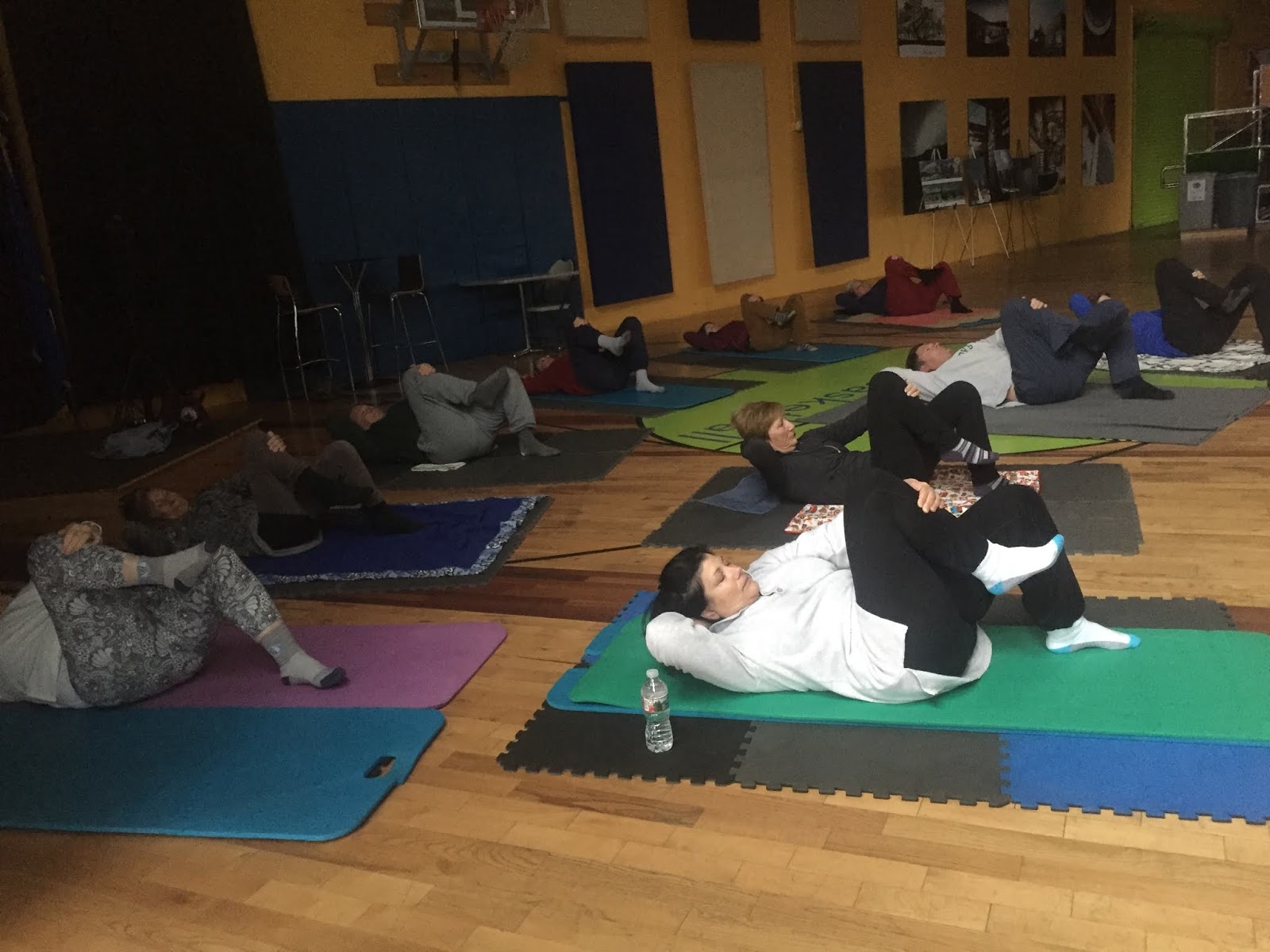
Next week’s (Feb. 25-Mar 2) Feldenkrais Awareness Through Movement class is a short, simple and whole body class that provides comfortable movement in hips, legs, knees, feet, spine, neck, chest, arms and shoulders. Pretty much everything, but especially organizing in feet, legs (and knees), hips and pelvis. 

It is a straightforward lesson that is a particularly good one for people who need grounding and balance, or who are new to Feldenkrais or may have started class when we did a more complex, longer or vigorous lesson. 

This class will take you in a simple way into your whole body, help you feel a deeper sense of the dynamics of your posture, flexibility, balance and stability. It will pave the way to a new understanding of your skeletal support and structure, and so is a good introductory lesson and reinforcement of basic Feldenkrais principles, e.g., moving slowly, small and mindfully; distributing work through your whole skeleton, not doing any movement that is straining or painful in any way, beginning to know what our movement habits and patterns are, where we find resistance or limitation and where there is ease. Then the nervous system is engaged and the updating of the brain map begins. 

If you’ve been hesitating coming to class, or have been only once or twice, I invite you to join us for class next week. It will help you feel more confident about the process and your relationship to improving your learning and moving. 

Please come 15 mins early to your first class and be sure to let me know you are coming. I will confirm that I’ve heard from you and send you the class handout if you don’t already have one. That way, we can arrange to talk before class, either via email, on the phone or meet face to face. Or you can contact me using the form on this website, at the top right hand corner. 

In any case, let me know if you have any questions, or something to discuss.  And when coming to class, be sure to dress warmly in layers. Bring water, a blanket and towel. 

Tues noon-1:30pm at 250 Bell St., park behind and come in the back door;  
—Thurs 5-6:30pm at the Reno Buddhist Ctr., come down the long hallway to the Hiroma Hall;
Saturday 10-11:30am at 250 Bell St., park in front and come in the front door. 

Happy Sunday! Looking forward to seeing you. 
Carole 


Friday, February 15, 2019

Winter Feldenkrais classes in Reno -- in case you are wondering about weather-related cancellation policy

Dear friends and students,

During the winter months when the weather is often cold, snowy, or rainy and unpleasant, Feldenkrais Awareness Through Movement classes in Reno pretty much always occur as scheduled.  The atmosphere inside is heart-warming,  healthy, open,  mindful and friendly -- no matter what the weather is doing or what the world outside is like.

I feel strongly that the consistency of classes is an important part of developing our commitment to wellbeing, self-care, and/or healing or improving whatever elements of personal growth that we are working on.  And equally important, that this commitment helps everyone around us and beyond. Intention is powerful.

Thus the only time I cancel a class is if the weather and/or streets are genuinely dangerous or if I am sick. Otherwise classes go on.  If only a few people attend, that is fine. Lucky for them! It just means that we sometimes have smaller, more intimate, lively groups, with more individual support and sometimes a little more playful.

Valentines Day at the Reno Buddhist Center on Valentine's Day, Feb. 14 was one of these; we ate chocolates together and did my favorite seated lesson, an interesting, rich and varied lesson that includes working with the eyes and the entire body.  We are doing the same lesson tomorrow at 250 Bell St., 10 am, and I will be there.

If I ever do cancel a class, I will text you if I have your phone numbers. I will also post a notice here on my website, and on both of my facebook pages. And you can always contact me to ask if you have a concern. But generally speaking, I don't cancel classes unless the weather is truly treacherous (which actually has never happened), or if I am sick or out of town, and neither of those things happens often.

So now you know.  I'll see some of you tomorrow! Just drive safely if the roads are icy. I'll be there.


Monday, February 11, 2019

Whole body + eyes workout in a seated position. Feldenkrais® class week of Feb. 4-9.


A chair lesson that works on the whole body, connects to the pelvis and improves turning, while aligning and organizing your skeleton, AND working on vision. 

CLASS THIS WEEK: (all 3 days, we will study the same lesson) Tues Noon - 1:30pm, 250 Bell St., Thurs 5-6:30 pm, Reno Buddhist Ctr., Sat. 10 am-11:30 am, 250 Bell St. Please join us! 

Use the contact form above right if you are a first time student or want to ask questions, get more information. Plan to come 15 minutes early, and email me for the class handout. 

Dress warmly, wear layers, bring a blanket or similar, and water. Looking forward to this great class and to see you there!

Carole 


Thursday, February 7, 2019

Reducing Injuries by Increasing Self-awareness, Internal Stability and Strength with Feldenkrais: In Healthy Beginnings Magazine - January 2019

Injuries are awful and many are avoidable. 
Learn to stop injuring yourself in 2019! 
You might consider the Feldenkrais method when looking to ease joint pain and other injuries en route to a healthier 2019. Courtesy photo

Reducing injury by increasing self-awareness, internal stability and strength with Feldenkrais!


Let’s face it — injuries are horrible, ghastly. They happen quickly, and suddenly we are hurt or in the hospital. Life gets painful, scary and complicated.
With serious injuries like broken bones or severe tissue damage, our problems accelerate. It makes sense, as chaotic and difficult as life is now, to minimize the likelihood of injury causing accidents.
To do this, we’ll focus on the 2 kinds of accidents/injuries that can be avoided:
  1. The first is things that happen to us because we aren’t paying attention to our environment, like falling because we tripped on a rug or a dog, or running into something because we weren’t looking, or hurting ourselves with a tool by not watching what we’re doing.
  2. The second is different — injuries that happen because we aren’t paying attention to our bodies.
Our bodies routinely send us signals (discomfort/pain) that something needs to change, but we ignore them or don’t recognize the warning; or don’t take it seriously, thinking somehow that pain is OK: the “no pain, no gain” mentality. Then suddenly we’ve herniated a disc, torn a muscle or ligament, or worse. And there is no “do-over.” It’s too late. The accident has happened.
In Feldenkrais, we step back and find a better strategy. The first step is to acknowledge that we live mostly in our heads, with little awareness of our physicality, meaning we’re mostly unconscious of our bodies in space. We don’t feel our feet on the ground or our bottoms in our chairs; we have no clear idea how we move at all.
If we get interested in noticing our bodies and movement, we work with our nervous systems in a totally new way. This helps neural pathways form and new brain mapping occur.
The Feldenkrais Method classes and private sessions, aka somatic education or neuromuscular re-education, does this with slow, small, non-habitual movements, teaching us about our movement habits, revealing what is easy for us, and, what is not.
Learning about our habits is critical because they contribute to our pain, weakness, lack of balance, bad posture, and disconnection between body and brain — all things that can cause injury.
David Zemach Bersin, one of my Feldenkrais teachers and co-founder of the Feldenkrais Institute in NYC, says, “The Feldenkrais Method is a sophisticated form of sensory-motor education, which interacts with the brain in a special way to improve the comfort and function of the body … The exercise are designed to engage the brain’s ability to change in response to stimulus (neuroplasticity) to improve the body’s underlying neuromuscular and skeletal organization. It improves the way the brain coordinates posture and movement.”
This means we develop new connections with our skeletal structure/support that our brains recognize quickly and instinctively. We can avoid injury because of this increased awareness.
We feel our bones — and a new relationship is formed connecting us with the ground below. This affects our balance, alignment and how we move. We “occupy” our bodies more fully, with confidence and intelligence because we sense our skeletal support.
Look at people on the street or in your office. Very few move with awareness or a sense of conscious connection to themselves or the environment. When they do, you can see it and it is impressive.
Here are some ways you can begin to do this:
  1. Stand and notice which leg and foot you stand on more. Shift your weight from foot to foot. Feel the difference.
  2. Visualize the lines of your legs, from your feet to knees, to your pelvis.
  3. Wiggle your toes, feel how the bones in your feet and ankles provide support for the rest of your body.
  4. Notice gravity coming through the bones in your feet; practice standing with pressure on different parts of your feet. Hold onto something for stability; keep your movements small and slow.
  5. Revisit these skeletal connections often and re-experience them.
This will help you begin the process of increasing body awareness and reducing accident and injury in your life: from your yoga class, to the gym, to your home. Improving your connection with yourself, engaging your brain and body, and being more effective in the world around you is a fabulous way to start 2019!
Wishing you an accident-free, more conscious and joyful new year!
If you have questions or want more information about the Feldenkrais Method, please use to contact form above right to reach me. Thank you!  Carole Bucher, BA, GCFP

Sunday, February 3, 2019

A testimonial from a new student in Feldenkrais class yesterday

It is always heartening when someone really has a positive experience from their first Feldenkrais Awareness Through Movement® class. Here is one such:

"I attended this class this morning. It was my first ever Feldenkrais Method experience. I was utterly gobsmacked at the wonderful difference in my body from the beginning of the class til the end. Thank you, Carole. You made my day! Your class will have a positive effect on my health and wellness all week until the next class."

If you want information about classes or the Feldenkrais Method, please use the contact form above right to contact me. 

There is so much you can learn to do to feel and move better and more comfortably!

Wednesday, January 16, 2019

The Feldenkrais Method®: Get Stability and Pain Relief Doing TMJ and Pelvis Work

Class This Week: 


As I have taught and studied Dr. Feldenkrais' work during the last 10 years, I sometimes encounter lessons which surprise me and remind me of his amazing understanding of the intricate relationships between the nervous system, brain and body. In Awareness Through Movement® class yesterday I had such an experience. The lesson was a jaw -- TMJ (temporomandibular joint) and pelvis-knee lesson, with an amazing surprise. The lesson also has a huge impact on balance! 
We worked deeply and quietly with the eyes, jaw and pelvis, and coordinated taking the knees right and left. In the middle of class we got up and walked a bit to sense what had changed on the side we had just worked on -- and the experience was phenomenal. The entire right side had stabilized and organized in a way that was exponentially beyond what it seemed we had done. BALANCE was profoundly affected, meaning the work went deep into the organization of body via the work with eyes and jaw, the nervous system.
There are more than 2000 Feldenkrais® Awareness Through Movement® lessons, each meticulously designed to address particular areas of the body and function, using self-awareness during non-habitual, mindful movement. Of these, about 750 were developed by Dr. Feldenkrais himself. The balance are extensions or variations developed by his small group of students, early students who worked and trained directly with Dr. Feldenkrais, and others who completed the 1000+ hr Feldenkrais professional training after Feldenkrais' death in 1984.
Dr. Feldenkrais was literally a movement genius, motivated and inspired by his own debilitating injuries, and informed by his deep knowledge of judo, yoga, and athletics generally. Add to that mix his lifelong study of how humans learn, combined with his training in physics and engineering, and the result is a body of movement lessons and work unlike any other. I hope you will join us soon and experience this work for yourself. 

Winter weather is keeping a lot of people home, but if you have trouble with balance, pain or movement in spine, back, hips or legs, I hope you can join us. Remaining classes are Thurs and Sat. We do the same lesson all week long, our week beginning on Tuesday and ending on Saturday.
Please contact me for more information at renofeldenkrais.blogspot.com and use the contact form at the top right of this page. I look forward to hearing from you! Best wishes and stay warm! 

Best wishes and stay warm!


Carole 

Saturday, January 12, 2019

The Feldenkrais Method®: Convergence of Movement, Pain Reduction and Self-Awareness

The Feldenkrais Method is distinguished from most other movement modalities (yoga, Pilates, T'ai Chi) by the fact that there is no 'form,' no ideal movement, no ultimate goal other than increasing our ability to sense and feel movement in our bodies, initially exploring existing movement habits, and eventually embarking instinctively and intelligently on a journey leading to more well-organized,  pain-free, aligned, effective movement.  People who use the Feldenkrais Method know this to be true.

The initial objective is to practice 
using sensation and attention to learn through self-sensing about your movement ease and movement limitations. This creates a baseline of knowledge from which to measure change, to bring about mindful movement improvement, at the level of the skeleton and the nervous system, i.e., the brain.

The shape, speed, size and trajectory of any movement or movement sequence that you do, whether in Awareness Through Movement® classes or Functional Integration®, is determined entirely by what feels comfortable to you in that moment. 

You may even choose to do the movement in your imagination, if the initial exploration of a movement feels unsafe,  uncomfortable or inaccessible or limited in any way. This is one of Dr. Feldenkrais's discoveries -- that doing movement by visualizing is a powerful force for improvement and is completely safe. Elite athletes and performers use the technique, going over and over a routine or sequence in their minds. Then suddenly range of movement improves, alignment and organization is better. Many things happen during visualization that we cannot measure, with or without technology. 

Moving mindfully, whether in reality or by visualizing, also helps to reduce pain and muscular stress, improves breathing, balance and allows the body to find itself in a way that is reminiscent of how we were as children, when we were free of the self-consciousness we are burdened by as adults. We become more free in ourselves.

In this relaxed, observant and open state, many parts of ourselves can become more responsive, vital and creative, more available to us. Our senses are more alert, our attention improved, our awareness of our surroundings is heightened. Life can become more vibrant and rich, more conscious.  Here is what painter, writer and philosopher William Segal wrote about attention and consciousness:  

“When one first begins to work with conscious attention one discovers that the subsystems of body, feelings, and mind function inefficiently and disharmoniously. Yet the simple awareness of misalignment may introduce an element capable of binding the disparate parts into an integrated whole. With sustained awareness comes a heightened sensitivity, openness, a quiet mind. Man’s structure becomes receptive to the advent of fresh, vivifying energies descending from a mysterious source. This creates a field, where higher energies can transform the lower.”

~ William Segal   (quote thanks to Ian Sanders)


Thanks for reading, 

Carole
Carole Bucher, BA, CGFP
Reno Feldenkrais Integrative Movement

Saturday, January 5, 2019

What is Functional Integration®? Gentle skeletally-oriented, individual lessons, that create lasting change through the nervous system.

This charming short youtube film created by my equally charming and erudite French colleague, Stephanie Menase',  is completely unlike any other film about Feldenkrais Functional Integration (known also as FI). It is brilliant, educational and absorbing. 


And inspiring! During the very unusual and effective one-to-one process of Functional Integration, you get a clear taste of what the work is like, how it proceeds, relieves pain, organizes the body for effective movement and gives you an example of what your own experience in an individual Feldenkrais session might be like. 


The remarkable thing is that Stephanie is able to convey all of these subtleties with just her fingers and hands, using a tiny little stuffed Frenchman doll to represent her client. You will be amazed!


The gentleness of her movements and the refinement of her words perfectly conveys the sometimes magical possibilities that one encounters with the Feldenkrais Method. 


I hope you will enjoy it as much as I did! 

With best wishes for a happy, movement filled 2019!

Carole

Thursday, January 3, 2019

Get ready for the New Year! 2019 Feldenkrais® classes start Jan 8, 10 and 12.

Happy New Year!
2019 could be a year in which calm, physical grounding and the ability to respond with intelligence from our hearts will be important. I invite you to explore these qualities in yourself as you learn to connect to yourself more deeply in Feldenkrais Awareness Through Movement® classes. Using sensation and attention, we use non-habitual movement to study our existing patterns and habits of movement, as well as thinking, emotion. We reconnect our brains and bodies, reduce pain, rediscover ourselves, restore balance and joy, so that we can meet each day in a more mindful, active, and effective way.

Classes begin again next week on Tues, January 8.
The class schedule and cost are the same as last year. I've reposted them below. If you are interested in attending class for the first time, here's what to do:
  • Email me for the important class hand info (How to get the most from a Feldenkrais class). 
  • Come 15 mins early to meet with me when you come to your first class.  
  • Bring a blanket or similar, a small towel, water and dress in warm layers in winter. 

We work on the same lesson from Tues-Sat., to give you the opportunity to do a class more than once, by far the most beneficial way to progress, though our busy schedules may challenge us.  If you can,  make a commitment to come to at least 3-5 classes in a row (one or more per week), to create a base from which your learning will ground itself and accelerate.

Dr. Feldenkrais designed lessons to be done at you own level, including, when necessary, visualizing or imagining doing certain movements that are difficult, and never doing anything that strains you or causes pain. If you do, this is not doing Feldenkrais. All of this information is addressed clearly in the class handout.

Movement is the vehicle for sensing and feeling what is easy for us and what is more challenging, then slowly going forward and improving from this place. There is no prescribed 'form' -- you seek your inner capacity, then gently undertake the individual, non-habitual movements from that mindful place, even if the lesson becomes more vigorous.

Please contact me (using the contact form on my website, upper right corner) if you have any questions about classes, the Feldenkrais Method, your situation, or my training.

2019 CLASS SCHEDULE
--TUESDAYs at Noon-1:30,  250 Bell St., park in the rear lot, enter through the back door.

--THURSDAYs at 5:00-6:30 pm,  Reno Buddhist Center, 820 Plumas, at Taylor. Enter on Taylor St.,  all the way to the back of the hallway, in the Hiroma Room.

--SATURDAYs at 10-11:30 am, 250 Bell St., park in front, enter through the front door.

COST:  $15 drop-in, 10-class card for $120, and a need-based sliding scale for those who need it. I don't take credit cards at this time.

I look forward to working together this year to bring a more meaningful connection with ourselves to life, enhancing our ability to move, think, act and be more effective in the world in ourselves and around us. If you have any questions, please contact me. Meanwhile know that with just a little commitment and curiosity, you have far more ability to improve your movement comfort, efficiency and wellbeing than you may imagine.


Best wishes and awesome movement!

Carole Bucher, BA, GCFP
Reno Feldenkrais Integrative Movement

Tuesday, December 18, 2018

How to develop your self-awareness and make your life better with Feldenkrais.

Dear Students and Friends, 
As we plan for the coming new year, this is a good time to gently look inward and get more in touch with our personal landscape, inner and outer. This simple (though perhaps not easy) act will greatly strengthen our ability to move forward with our planning and our plans.
Oddly, the great reward of this process, increased self-awareness, is a personal attribute that most of us think we already have and don't really need. This response, however, actually shows how little we see ourselves, how we don't spend enough time or effort paying attention to our inner workings. When we do, we see clearly how much of our lives we spend in autopilot mode.
Imagine the possibilities! What would our lives be like if we had more frequent, deeper, clearer and genuine self-awareness? A thrilling idea...
Ironically, if I can't see or sense myself with accuracy (and without judgment), I won't see what I lack, how I really am, and how much time I am not present. Nor will I be motivated to undertake a real exploration of what greater awareness can mean for the fabric of my life, my relationships, my feeling of self, my ability to create, perform, produce, love, and to live fully.
Thus the first step to making progress is to sense/see that I am more disconnected from myself and the world around me than I think. That I use only a fraction of my 12 billion brain cells. And if I wish to embark on change, I need to begin to learn to pay more attention to how I am: what I do with myself, what my habits are, physically, mentally, emotionally. And how my autopilot mode directs about 95% of my life and LETS me think I am actually present, when in fact, I am not.
Below, my December article in Healthy Beginnings Magazine, lays out some preliminary groundwork to begin this process. I hope you find it helpful and inspiring for the New Year. It is something that can measurably improve the quality of your life and wellbeing -- it costs nothing, and requires no new equipment, except hooking up and accessing the stuff you already have, i.e., your brain and your body!
Relative to 'hooking up,' remember that Feldenkrais Awareness Through Movement classes start again the week of January 7, 2019. The first class will be on Tuesday, Jan. 8, at noon, at 250 Bell St. My contact info is below if you have questions or would like to schedule time to talk.
Meanwhile, be happy, move well and make comfort a true priority. That's when we learn best! 
With warm wishes, Carole


Embracing self-awareness – what does it take to make a difference?


Tabor Griswold, program director for the UNR School of Medicine’s Nevada Health Workforce Research Center, participates in a Reno Feldenkrais Awareness Through Movements class. Photo: Carole Bucher
Self-Awareness as a Personal Strength - Part 2 
As a personal empowerment skill, experts agree there’s nothing more critical than self-awareness. Yet habit, ego, social pressures and even too few neural pathways prevent people from working on it consciously. They usually resort to it only when facing an inescapable need for change in themselves or their environment.
Below are certain qualities that self-awareness is known to improve. These characteristics accelerate personal growth, improve relationships with family and friends, and increase your ability to contribute effectively to community on every level, even politically. See what resonates:
  1. Being proactive instead of reactive — make better choices in what you say and do.
  2. Becoming more neutral in discussions — listen more carefully.
  3. Developing healthy boundaries — take things less personally.
  4. Understanding that mistakes (yours and others) are necessary to grow and learn.
  5. Transforming judgment into curiosity — be more interested in everything.
  6. Learning what makes you ‘tick’ so you can see yourself and others with more humanity, as thinking, feeling, conscious beings.
If these possibilities inspire you to explore, let’s deconstruct how lack of awareness can derail your possibilities; create negative, inauthentic behaviors; and generally disempower you. It goes like this:
  • Thoughts arise out of the blue (based on what you see/hear, your associations, memories, insights, even intuition).
  • Thoughts produce emotional responses that you are often not aware of.
  • Emotional responses can be felt/sensed in your body as physical feelings.
  • These feelings/sensations can evoke actions or reactions that you may carry out, consciously or unconsciously.
E.g., you see something that reminds you of a sad or violent movie; you get depressed or angry without noticing, argue with your colleagues or spouse, or worse, completely misunderstand someone’s behavior because you’re lost in an imaginary place having NOTHING to do with reality. You might even get into a physical fight based on “nothing,” although you think you’re right. Serious uh oh! Our thoughts aren’t trustworthy!
However, when you learn to feel more deeply in your body, you can pause and self-inquire, use the physical feelings as reminders to check in with yourself, and test the validity of your conclusions or judgments before you say or do anything.
You can track the physical and emotional feelings back to your thoughts and stop getting lost or dragged down an emotional rabbit-hole where distortion happens and bad choices loom. You can discover and assess the emotions underneath your reactions.
You’ll see that your perceptions are sometimes off base and/or disconnected from reality, especially about other people. Or, you may validate your perceptions. But you’ll avoid inaccurate conclusions and misunderstandings, large and small, because you are deciphering the feelings in your body intelligently.
The biggest, most mysterious benefit from self-awareness is your connection to the innate wisdom of your nervous system. Here, doors open to better physical, mental and emotional health. You get along better in the world, understand more, are less fearful and negative — an empowering payoff for your work.
Commit to learn about yourself — body and mind — and watch the transformation in your life — your gift to yourself and the world! Wishing you a wonderfully moving holiday!
Carole Bucher, BA, is a Guild-Certified Feldenkrais practitioner/teacher and owner of Reno Feldenkrais Integrative Movement. Visit renofeldenkrais.blogspot.com to learn more.
FOR MORE INFORMATION, USE THE CONTACT FORM AT THE TOP RIGHT OF THIS PAGE.